
Overview
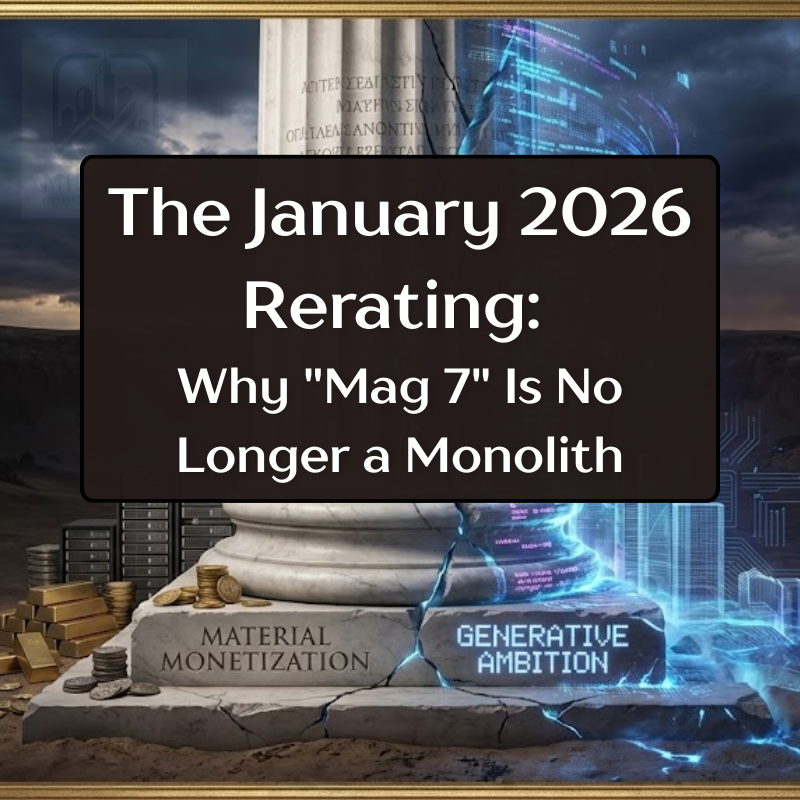
The final week of January 2026 marked a pivotal decoupling in the tech sector. Since 2023, the “Magnificent Seven” (or “Mag 7”) trade has been a rising tide that lifted all boats. Today, however, the market has begun to differentiate between generative ambition and material monetization. This report explores how the January 2026 rerating has created a valuation schism across the entire cohort—from NVIDIA’s infrastructure dominance to the floors of Alphabet and Apple. In this post, we hope to answer the critical question underpinning this rerating: are we witnessing an AI plateau in the stock market (via generative ambition), or simply a structural rerating of risk (via material monetization)?
Key themes explored in this “Recent News” post:
- Background on 2025’s Generative Ambition: We anchor the January 2026 re-rating around the concepts of Generative Ambition (GA) and Material Monetization (MM).
- The Microsoft Concentration Trap: We analyze the 12% single-day volatility in Microsoft and the revelation that 45% of its cloud backlog is tied to a single, venture-backed entity (OpenAI). Is Microsoft the enterprise backbone of AI, or is it a levered play on this venture-backed entity?
- Meta’s Green Light for CapEx: While Microsoft was punished for its spending on infrastructure (CapEx), Meta was rewarded. We break down how Mark Zuckerberg’s organic ad-revenue growth provided the permission slip for a $135 billion CapEx play, and why Meta’s vertical integration strategy is winning the narrative war around GA.
- Tesla’s Honorable Discharge and the Crossing of the Rubicon: We examine Tesla’s pivot from automotive fundamentals to the Optimus robotics narrative. We ask whether the scrapping of legacy production lines is a visionary transition, as Elon Musk claims, or a necessary cover for declining EV margins and free cash flow, as evidenced by their recent earnings call.
- GA and MM Mean Reversion: We conclude with insights for 2026 and assess the long-term outlook for GA and MM. As the Mag 7 growth rate decelerates toward the mean, a process referred to as mean reversion, we examine the changing of the guard and why the broader market is finally beginning to close the performance gap.
As always, this post is for information purposes and not intended to be taken as financial advice. For similar educational information on the market to Think Deeper, Invest Wiser, as well as individual stock analyses, check out our homepage, and make sure to follow us on Facebook, Instagram, and Twitter/X.

I. Background of 2025’s Generative Ambition
The tech sector entered 2026 facing a fundamental shift in institutional sentiment. Throughout 2024 and 2025, the Mag 7 functioned as a collective proxy for the AI revolution, riding a wave of uncritical optimism that lifted the entire cohort. During this period, investors primarily measured success by Generative Ambition (GA)—the aggressive yet strategic pivot toward generative AI infrastructure, significant capital expenditures, and the rapid deployment of Large Language Models such as OpenAI’s ChatGPT or Google/Alphabet’s Gemini.
While the cohort once moved in lockstep, the January 2026 rerating has highlighted a duality of roles. NVIDIA has emerged as the industry’s primary tool provider, selling the “lumber” (high-performance compute chips) for others’ GA. Meanwhile, Apple has positioned itself as the “Late Adopter” of Material Monetization, focusing on hardware-driven AI revenue through consumer device upgrades rather than speculative cloud service agreements.
Since this growth, investors have become increasingly critical of this GA pivot, referring to the Mag 7 as an AI bubble. Nowhere was this more critically visualized in the graph below from Bloomberg News, illustrating the “bubble”-like nature characterized by circular inflows and outflows:
Figure 1. Inflows and Outflows for Major Generative AI Companies

This monolithic performance and generative ambition have been further “re-rated” in the final week of January 2026, dubbed the “January 2026 rerating.” This rerating marks a further shift in the market from rewarding future potential (via Generative Ambition, or GA) to demanding Material Monetization (MM)—the tangible earnings and core fundamentals that validate astronomical valuations. As Cimino (2026) notes, by the end of 2025, the aforementioned rising tide had already begun to recede, with only two members of the Mag 7 (Nvidia and Alphabet) actually outperforming the S&P 500’s 16.4% return.
The “January 2026 Rerating” identifies the precise moment when the intersection of GA and MM became the sole arbiter of market value. Soni and Sophia (2026) note that while investors once tolerated soaring capital expenditures, they now quickly punish firms that fail to deliver immediate payoffs. This decoupling signifies the end of the “build-it-and-they-will-come” era, replaced by a rigorous requirement for measurable ROI (MarketMinute 2026a). In this landscape, GA acts as the catalyst for entry, while MM serves as the anchor, determining which tech giants remain “magnificent” and which succumb to mean reversion.
2. The Microsoft Concentration Trap
Microsoft (MSFT) triggered the week’s most significant structural event when its stock plummeted 12% in a single trading session, marking a rare bout of extreme volatility for a supposed “fortress” balance sheet (Bloomberg Podcasts 2026). While Microsoft remains a leader in Generative Ambition (GA), the market has begun to scrutinize the quality of its Material Monetization (MM).
The primary catalyst for this rerating was the revelation that nearly 45% of Microsoft’s future cloud revenue backlog is now tied to a single, venture-backed partner: OpenAI (Joseph Carlson 2026). This “closed-loop” revenue structure (e.g., Fig. 1. Inflows and Outflows of Major GenAI companies above) introduces a degree of counterparty fragility that previously seemed absent from the enterprise software giant. Analysts are now debating whether Microsoft serves as the essential enterprise backbone of AI or simply functions as a levered play on a single startup’s solvency (Yahoo Finance 2026a).
We suggest that this concentration trap is due to three key factors: (1) circular financing risks, (2) capacity constraints relative to existing demand, and (3) a valuation premium or concern around it being a “value trap.” As with other stocks in this post, we refrain from referring to this stock as a “buy,” “hold,” or “sell” here.
2.1. Circular Financing Risks
The market now views Microsoft’s relationship with OpenAI as a form of circular financing. Microsoft provides capital to OpenAI, which OpenAI then returns to Microsoft in exchange for compute power, potentially inflating cloud revenue metrics without a diversified customer base (Joseph Carlson 2026).
2.2. Capacity Constraints vs. Demand
During the earnings call, management acknowledged that while Azure revenue grew 17%, growth remains constrained by infrastructure capacity (Bloomberg Podcasts 2026).
2.3. The “Value Trap” Concern
Despite having millions of Copilot users, the concentration of future growth in a single partner has led investors to question whether Microsoft can maintain its premium valuation if OpenAI faces a funding crunch (Yahoo Finance 2026a).
By revealing this concentration, Microsoft effectively introduced structural skepticism into its long-term growth narrative. Investors are no longer satisfied with broad GA; they are demanding a diversified path toward MM that does not rely on the survival of a single high-burn partner.
3. Meta’s Green Light for CapEx
While Microsoft faced a penalty for its capital intensity, the market granted Meta (META) a definitive green light for its staggering $135 billion infrastructure bet (Bloomberg Podcasts 2026). This divergence highlights the critical role of Material Monetization (MM) in justifying Generative Ambition (GA). Unlike its peers, which rely on fragile third-party dependencies, Meta has successfully tethered its AI spending to its own high-margin advertising ecosystem (Yahoo Finance 2026a).
Mark Zuckerberg is winning the “narrative war” by proving that AI can immediately improve core business functions. Meta reported a 24% year-over-year revenue increase, driven by a surge in ad impressions across its “Family of Apps” (Soni and Sophia 2026). Because this growth is generated organically rather than through interdependent partnerships, the market views Meta’s massive CapEx as a defensive moat rather than a structural risk (Yahoo Finance 2026).
We think Meta has two advantages here: (1) vertical integration, and (2) a value play within a larger “growth” sector. Consistent with other stocks in this article, we refrain from calling this “buy,” “hold”, or “sell.”
3-1. The Vertical Integration Advantage
Meta’s strategy of controlling the full stack—from the Llama foundational models to the custom “MTIA” silicon—reduces long-term reliance on external chip providers. This vertical integration ensures that their GA is purpose-built for their specific MM needs (Bloomberg Podcasts 2026).
3-2. A Value Play in a Growth Sector
Despite its aggressive spending, Meta continues to trade at a forward P/E of 22.8, a significant discount compared to the broader “Mag 7” average of 28.3 (MarketMinute 2026b). Analysts note that Meta is currently the value play of the group, offering higher organic growth rates while maintaining a more disciplined path to AI-driven ROI (Yahoo Finance 2026).
By successfully demonstrating that AI can drive ad-targeting precision and user engagement, Meta has established the most direct path from GA to MM. Zuckerberg’s strategy suggests that in a high-stakes environment, the market will tolerate “moonshot” spending only if the underlying cash flow is robust enough to self-fund the journey (Bloomberg Podcasts 2026).
Finally, let us look at another value play in this growth sector— Alphabet (GOOGL). Alphabet—anchored by Search and YouTube advertising—grants a “permission slip” for GA (Reuters 2026), and this structural stability enables Alphabet to fund high-stakes ventures (such as Waymo). In the January 2026 rerating, the market has begun to value this “Search-to-Service” pipeline as a more sustainable path than pure GA, particularly given Waymo’s dominant presence in the Bay Area with a fleet of approximately 1,000–2,000 robotaxis (Seeking Alpha 2026).
4. Tesla’s Honorable Discharge and the Crossing of the Rubicon
Tesla (TSLA) remains the most polarizing entity in the 2026 rerating, as Elon Musk attempts to pivot the company’s narrative from a struggling automaker to a dominant robotics powerhouse. This shift represents an extreme bet on Generative Ambition (GA) to offset a clear stagnation in Material Monetization (MM) within its core automotive business (Bloomberg Podcasts 2026).
The recent earnings call confirmed a troubling trend: Tesla saw its first annual decline in automotive revenue, with margins squeezed by aggressive price cuts and dwindling regulatory credits (Yahoo Finance 2026a). In response, Musk announced the “Honorable Discharge” of legacy production lines for the Model S and X to make room for the Optimus humanoid robot factory in Fremont (Joseph Carlson 2026). This pivot occurred as core automotive sales revenue fell 11% year-over-year (Argus Research 2026). However, a nuanced MM counterpoint exists in the Energy Generation and Storage segment, which achieved record quarterly revenue of $3.84 billion, up 25% (Tesla 2026). This success serves as the temporary MM floor supporting Tesla’s broader GA transition.
In any case, this pivot away from MM toward (further) GA during the Q4 earnings cycle has been described by other commentators as “crossing the Rubicon“—a reference to Julius Caesar’s point of no return in 49 BC that fundamentally altered the identity of the Roman Republic (Yahoo Finance 2026b). By prioritizing “Physical AI” over its legacy identity as a “car company,” Tesla has reached a definitive “burn-the-ships” inflection point that leaves no room for retreat (Subramanian 2026). We suggest that crossing the Rubicon is characterized by xAI “shared braining,” regulatory ceilings, and competitive realities.

4.2 The xAI Shared Braining and Further AI Circularity
The January 2026 rerating has also brought Tesla’s capital structure into focus. Tesla disclosed a $2 billion investment in xAI, creating a “Shared Brain” dependency where Tesla’s physical assets (Optimus and Cybercab) are tethered to a private, separate AI entity (Reuters 2026). This mirrors the “Concentration Trap” identified in Microsoft’s relationship with OpenAI, suggesting a similar risk of circular financing (see, again, the circular diagram in Fig. 1).
4.3 The Regulatory Ceiling and Competitive Reality
Despite the GA narrative, Tesla faces a significant “Material Monetization” ceiling. The NHTSA Part 555 exemption currently caps production of steering-wheel-less vehicles, such as the Cybercab, at 2,500 units annually (Seeking Alpha 2026). Furthermore, while Tesla has begun removing safety monitors in Austin, its fleet of approximately 255–500 units trails significantly behind Waymo’s established scale (Yahoo Finance 2026c).
4-1. The Robotics Gambit
By framing the decline of its vehicle business as a strategic transition, Tesla is attempting to maintain its “Technological Monopoly Premium”. The company aims to achieve a 1-million-unit annual run rate for Optimus, a goal that skeptics view as a necessary distraction from declining free cash flow (Joseph Carlson, 2026) and therefore as a pivot away from MM toward pure GA.
4-2. The xAI Integration
Tesla’s $2 billion investment in Musk’s xAI startup further complicates the GA narrative. The plan involves using the “Grok” model to orchestrate fleets of robo-taxis and robots, yet this deepens the company’s “Interdependent Concentration” risk by tying Tesla’s future to a separate, private entity (Bloomberg Podcasts 2026).
4-3. MM Preacity in Tesla
While the “Robotics Pivot” is visionary, the immediate MM remains fragile. Without the high-margin cushion of its automotive segment, Tesla’s valuation rests entirely on its ability to solve the precarity of autonomous hardware—a feat that has remained “just around the corner” for years (Yahoo Finance 2026a).
Tesla is no longer being graded as a car company, but as a venture-scale robotics firm. The market is currently deciding if this transition is a visionary evolution or a tactical cover for a core business that has hit a structural wall. Tesla continues to be one of the most speculative of the Mag 7 companies and therefore the company that relies most on GA relative to MM, reflected in its forward P/E of 227.5 (LSEG Data & Analytics 2026), compared to a forward P/E of 28.3 for the entire Mag 7 (MarketMinute 2026b).
5. GA and MM Mean Reversion in the January 2026 Rerating
The era of “Magnificent Seven” exceptionalism is yielding to a more traditional market cycle: mean reversion. For two years, these firms enjoyed a valuation premium based on the sheer scale of their Generative Ambition (GA). However, as their growth rates inevitably decelerate toward the long-term historical mean, the market is shifting its focus toward the durability of Material Monetization (MM) (Bloomberg Podcasts 2026).
Bloomberg Podcasts (2026) highlights that for the first time since the AI gold rush began, the market has stopped grading on a curve. This “January Rerating” indicates that investors are no longer satisfied with high-level AI promises; they are rotating into sectors and firms where the gap between spending and revenue is shrinking (Yahoo Finance 2026a). As Joseph Carlson (2026) observes, the market sentiment has fundamentally shifted—momentum is being replaced by fundamentals; in other words, GA is being replaced by MM.
5-1. The Changing (Rerating?) of the Guard
While the aggregate tech index remains resilient, underlying performance is fragmenting. Meta’s organic vertical integration allows it to maintain a growth premium, while Microsoft’s concentration risk raises structural skepticism about its long-term solvency as an AI backbone.
5-2. The Broad Market Recovery
As valuation air escapes the most speculative GA plays, capital is flowing back into the “S&P 493.” These companies, which lagged during the AI frenzy, are now benefiting from the very tools the Mag 7 built, often at a fraction of the cost (Yahoo Finance 2026a).
5-3. 2026 Outlook: The S&P 497?
The long-term outlook for GA remains robust, but the winners of 2026 will be defined by their MM efficiency. Rather than being a permanent status, the “Magnificent” label is a variable that must be earned each quarter through realized cash flow, not speculative narratives (Joseph Carlson 2026) that primarily revolve around generative AI gambits.
The decoupling we witnessed in January 2026, rather than being a temporary correction, may represent a structural shift in risk perception away from Generative Ambition (GA). As the market moves from the “pioneer” phase to the “production” phase for generative AI, the distinction between those with a permission slip for CapEx and those trapped in circular financing will likely sharpen. As such, the January 2026 rerating suggests that the “Magnificent Seven” is no longer a monolith; instead, investors are being forced to choose between the robust MM of Alphabet and Apple and the unbridled, “Rubicon-crossing” GA of Tesla (Yahoo Finance 2026b)
While we have primarily taken a skeptical approach to narratives around GA here, this post should not be constructed as a wholesale rejection of generative AI. As evidenced in the section above on Meta, generative AI can—and is—used to increase fundamental metrics, such as organizational revenue. But this type of CapEx spending should be supported by both backward-, current-, and forward-looking metrics, as evidenced by a broader approach that focuses on MM and GA rather than GA alone. A grounding in these fundamentals remains a core part of our approach, enabling you to Think Deeper, Invest Wiser. As such, we believe this is not an AI plateau, but rather a further restructuring or mean reversion that similarly prioritizes MM.
VI. References
- Argus Research. (2026, January 30). Tesla Inc. Analyst Report.
- Bloomberg Podcasts. (2026, January 30). Instant Reaction Earnings Roundup: Microsoft, Meta & Tesla Deliver Results. YouTube. https://www.youtube.com/watch?v=QOu090ED10c. Retrieved January 30, 2026.
- Carlson, J. (2026, January 29). Things Just Changed. Joseph Carlson After Hours. YouTube. https://www.youtube.com/watch?v=Zk8Q6rGfGf0. Retrieved January 30, 2026.
- Cimino, A. (2026, January 28). Only 2 “Magnificent Seven” Stocks Outperformed the S&P 500 in 2025. Are They Both Buys for 2026? Nasdaq. https://www.nasdaq.com/articles/only-2-magnificent-seven-stocks-outperformed-sp-500-2025. Retrieved January 30, 2026.
- LSEG Data & Analytics. (2026, January 30). TESLA INC (TSLA-O) company in context report. LSEG Stock Reports Plus.
- MarketMinute. (2026a, January 30). The Big Tech Gauntlet: AI Monetization and the High Stakes of 2026 Earnings. MarketMinute. http://markets.chroniclejournal.com/chroniclejournal/article/marketminute-2026-1-30-the-big-tech-gauntlet-ai-monetization-and-the-high-stakes-of-2026-earnings. Retrieved January 30, 2026.
- MarketMinute. (2026b, January 28). The S&P 7: Magnificent Seven Solidifies Dominance as 2026 Profit Projections Outpace Broader Market. MarketMinute. https://business.times-online.com/times-online/article/marketminute-2026-1-28-the-s-and-p-7-magnificent-seven-solidifies-dominance-as-2026-profit-projections-outpace-broader-market. Retrieved January 30, 2026.
- Reuters. (2026, January 28). Tesla invests $2 billion in Musk’s xAI and reiterates Cybercab production starts this year. https://www.reuters.com/business/autos-transportation/tesla-revenue-beats-estimates-despite-weaker-vehicle-deliveries-2026-01-28/. Retrievd anuary 31, 2026.
- Seeking Alpha. (2026, January 30). Tesla After Q4 Earnings: Autonomy Takes Over Fundamentals, Again. SeekingAlpha. https://seekingalpha.com/article/4864586-tesla-after-q4-earnings-autonomy-takes-over-fundamentals-again. Retrieved January 31, 2026.
- Soni, A., & Sophia, D. M. (2026, January 29). Big tech results show investor demand for payoffs from heavy AI spending. The Guardian. https://www.theguardian.com/technology/2026/jan/29/big-tech-earnings-reports-ai. Retrieved January 30, 2026.
- Tesla. (2026, January 28). Tesla Q4 Update. Tesla Q4 and FY 2025 Update. Tesla Investor Relations. https://assets-ir.tesla.com/tesla-contents/IR/TSLA-Q4-2025-Update.pdf. Retrieved January 31, 2026.
- Yahoo Finance. (2026a, January 30). Tesla, Microsoft, and Meta earnings analysis. YouTube. https://www.youtube.com/watch?v=hI-2ORezXNM. Retrieved January 30, 2026.
- Yahoo Finance. (2026b, January 31). Tesla just made it clear: It’s no longer a car company. https://finance.yahoo.com/news/tesla-just-made-it-clear-its-no-longer-a-car-company-181935814.html. Retrieved January 31, 2026.
- Yahoo Finance. (2026c, January 30). Tesla, Microsoft, and Meta earnings analysis [Video]. YouTube. https://www.youtube.com/watch?v=hl-20RezXNM. Retrieved January 30, 2026.
Leave a Reply